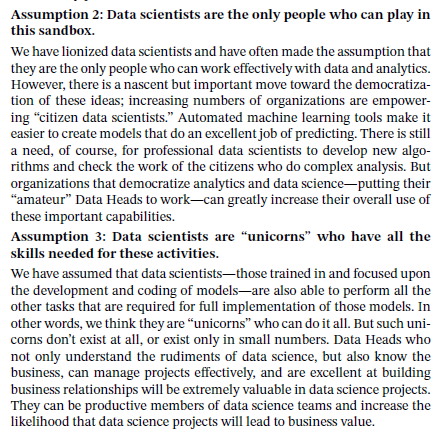
Note 1 — “Data scientists are the only people who can play in this sandbox.”
The book’s argument is basically: that era is ending.
Analytics and ML are becoming democratized. Better tooling, AutoML, BI platforms, AI-assisted analysis, etc. mean people who aren’t professional data scientists can increasingly build models, analyze data, and generate useful predictions.
But that doesn’t make data scientists obsolete.
It changes their role.
Instead of:
“I’m the person allowed to touch the data.”
it becomes more like:
“I understand the machinery deeply enough to build difficult things, validate what others build, and prevent everyone from confidently doing something stupid.”
That distinction is pretty important in 2026. The technical barrier to doing data science keeps falling; the barrier to doing it correctly doesn’t disappear nearly as quickly.
And the book introduces another useful character here: the Data Head — someone who may not be a hardcore model-builder but understands enough data science, business, and project management to make analytical work actually useful.
Note 2 — “Data scientists are UNICORNS.”
Because the interesting part is that the book is actually attacking the classic job-description fantasy:
Python + statistics + ML + software engineering + cloud + databases + visualization + communication + domain expertise + business strategy + stakeholder management + probably the ability to resurrect a broken production pipeline at 2 AM.
The authors' point is: that person either doesn’t exist, or exists rarely enough that designing teams around finding one is stupid.
Good data science is a team capability, not necessarily an individual superpower.
A strong Data Scientist doesn't need to personally dominate every part of the lifecycle. And someone who understands the business, can manage the project, understands enough data science to ask the right questions, and can communicate between technical and nontechnical people can be enormously valuable without being the person training the model.